Tomáš and Eve’s affair
The Glass RoomTomáš and Eve’s affair gives Tomáš a second, unusually candid intimacy while sharpening his fear of what his betrayal means for Zdenka. Eve, a local newspaper journalist, knows that he has another lover; he confides in her about Zdenka but conceals Zdenka’s name. Their relationship’s frankness does not remove its secrecy: a photograph taken in the Glass Room eventually records Tomáš and Eve holding hands, exposing to Zdenka the intimacy he had kept from her.
Eve and the clandestine relationship
Eve is a journalist on a local newspaper, and her own apartment in the city centre makes it easier for Tomáš to meet her than to see Zdenka. The apartment is only one room, with a single bed. Their encounters are described as brief and lacking particular passion; Eve directs what she wants, while Tomáš experiences their intimacy in a detached, almost clinical way, as physical relief. Even while with Eve, however, he feels guilty about Zdenka, whom he thinks of as his Ondine.
The relationship develops within a wider pattern of concealment. Tomáš has accompanied Eve on work trips and realises that he is in some way complicit in her clandestine affair with Oddball. Amused by the recognition, he tells Eve that there is another woman. Eve takes the news without jealousy: she had assumed as much. Tomáš describes the other woman as a hospital physiotherapist and dancer, but does not give her name. Eve’s easy acceptance makes him feel closer to her, yet it does not settle the question that troubles him. What matters to him is not whether Eve minds his other relationship, but whether Zdenka would mind.
Confession, guilt, and the Ondine image
Tomáš does not dare ask Zdenka the question he has put to Eve. He believes Zdenka would be destroyed by his unfaithfulness, and links that imagined devastation to the curse of Ondine: the lover who would die if she ceased to be loved. His affair therefore involves not only concealment but also a deliberate approach to a feared consequence. He wonders whether risking the curse might inject meaning into his life, and dwells on breathing as a condition of existence, turning its sequence of inspiration, respiration, and expiration into an image of birth, life, and death. The Ondine image makes his guilt inseparable from the threat of loss.
Tomáš’s disclosures to Eve deepen their companionship without resolving the betrayal. He tells her about Zdenka’s dancing, their intimacy on the floor of the Glass Room, and the trip to Paris and what followed, while still withholding Zdenka’s name. To Tomáš, speaking so freely feels less like betrayal than a confidence shared in the manner of doctor and patient, protected by secrecy. That interpretation reveals the division he maintains: he treats Eve as a trusted confidante while keeping from Zdenka the fact of their relationship.
The photograph and exposure
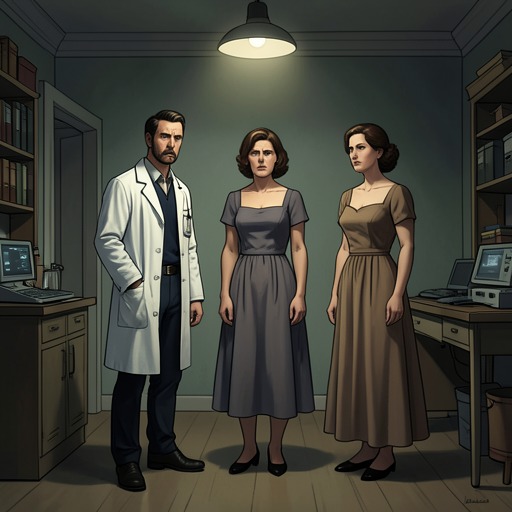
The hidden relationship becomes visible in a group photograph taken in the Glass Room. Tomáš and Eve stand together, with Zdenka and Tomáš’s wife, Hana, on the other side of a narrow chromium-clad pillar. Their gesture is concealed from the people beside them but preserved by the camera: Tomáš’s left hand is out of view, clasping Eve’s right hand, their fingers intertwined. It is not an incidental touch; the image records a practiced intimacy that the group arrangement otherwise disguises.
When Zdenka sees the photograph, the evidence shocks her. What she might have suspected is no longer merely memory or imagination: the camera has fixed Tomáš’s betrayal in an image. Hana puts an arm around Zdenka’s shoulders and explains that she did not know how to tell her and wanted neither to hurt her nor to let Tomáš continue deceiving her. The photograph thus reverses the affair’s governing arrangement. Tomáš had trusted private confession and hidden gestures to keep the relationships separate; the image makes the concealed bond legible to the person he feared would be destroyed by it.
Narrative significance
The affair turns on a contrast between what can be said and what can be seen. Tomáš can name Zdenka’s dancing and their history to Eve while withholding her identity, and he can interpret that confidence as harmless. But the camera preserves what his account cannot neutralise: his hand joined to Eve’s beneath the appearance of an ordinary group photograph. The evidence of the affair arrives not as a confession from Tomáš but as a visual detail that Zdenka has to read for herself.
Eve’s lack of jealousy offers Tomáš a comparatively candid companionship, not an escape from responsibility. His guilt persists because he imagines Zdenka’s response as catastrophic, and the Ondine motif gives that fear a language of breath, love, and death. By allowing the affair to remain both emotionally detached and consequential, the narrative sets Tomáš’s private rationalisations against the intimate proof that finally reaches Zdenka.